
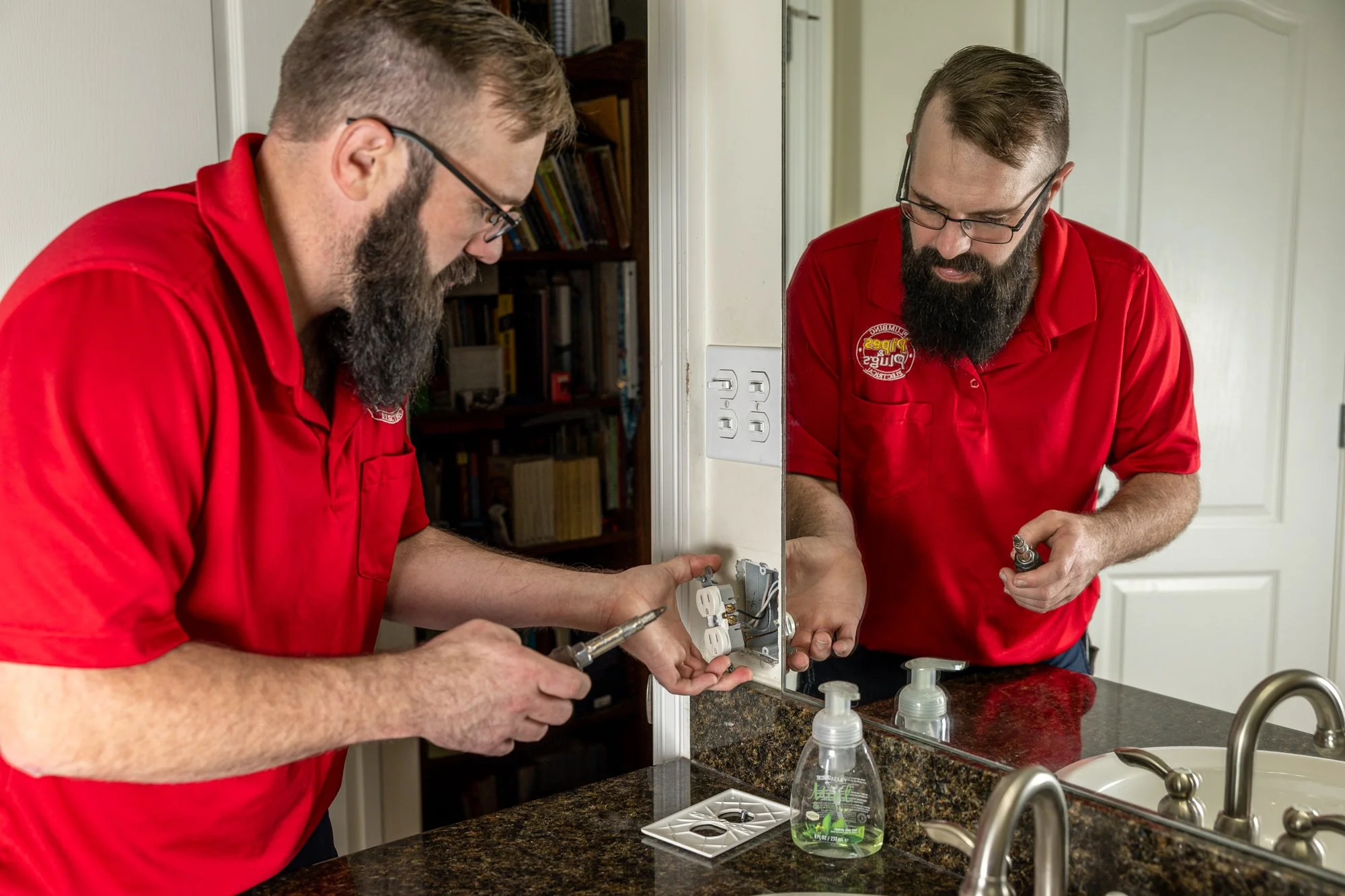
When several outlets go dead at once in a bathroom, kitchen, garage, or on the patio, the breaker panel is usually not the problem.
One tripped GFCI outlet is, and it is probably not in the room where the dead outlets are. Find it, press reset, and the power comes back.
If it will not reset, or it trips again right away, something on that circuit needs attention and that is where our electrical repair team comes in.
What a GFCI does
A GFCI, or ground fault circuit interrupter, watches the electricity going out to whatever is plugged in and compares it to the electricity coming back. If some of it is going somewhere else, which usually means through water, through a damaged cord, or through a person, it shuts the circuit off in a fraction of a second. That is the whole job, and it is a good one. Code requires them wherever water and electricity are close together: bathrooms, kitchen counters, garages, laundry, crawl spaces, and anything outdoors.
If you want the longer explanation of how the device works, we wrote one here: what is a GFCI.
Why one tripped GFCI kills outlets in other rooms
This is the part that catches people out. GFCIs are often wired so that they protect the outlets downstream of them on the same circuit. Those downstream outlets look like ordinary outlets. They have no buttons on them. But when the GFCI upstream trips, they all go dead together.
So the bathroom outlet that stopped working may be controlled by a GFCI in the garage. The patio outlet may be controlled by one in a laundry room. Builders in this area commonly chain a garage, an exterior outlet, and a bathroom onto one protected circuit.
That is why step one is not the breaker panel. Step one is finding the GFCI.
How to find and reset it
Work through this in order.
Unplug whatever was running when the power died. If a pressure washer, a space heater, or a wet extension cord caused the trip, leaving it plugged in means the GFCI will trip again the second you reset it.
Look for outlets with TEST and RESET buttons. Check bathrooms, the kitchen counter, the garage, the laundry area, outside walls, and any crawl space or utility closet. In Acadiana homes with raised foundations, do not skip the underside of the house and the exterior walls.
Press RESET firmly. You should feel a distinct click. A button that pushes in with no resistance and pops straight back out has not reset.
Check the dead outlets. If they are live again, you are done.
If nothing resets, check the breaker panel. Look for a breaker that is not fully in the ON position. Push it firmly to OFF first, then back to ON. A breaker that has tripped often sits in a middle position that looks close enough to ON to fool you.
If none of that works, or if you cannot find a GFCI anywhere, stop there. That is a wiring question, not a button-pressing question.
When it will not reset, and what that usually means
A GFCI that refuses to reset is telling you something. The common causes:
Moisture in an outdoor or garage box. Rain gets past a worn cover gasket, humidity does the rest. This is the single most common cause we see here, and after a storm week it is most of our GFCI calls. Sometimes the box just needs to dry out. Often the cover has failed and needs replacing.
A failed appliance or cord. A heating element breaking down, a frayed cord, a pump with a bad seal. Unplug everything on the circuit, reset, then plug items back in one at a time until it trips again.
The GFCI itself has worn out. These have a service life. Ten to fifteen years is a reasonable expectation, and a lot of Acadiana homes have originals well past that. A GFCI that will not reset with nothing plugged in is often just done.
No power reaching the device. If the breaker for that circuit is off or has failed, the GFCI has nothing to reset to.
A real ground fault in the wiring. Damaged insulation, a nicked wire behind drywall, a rodent-chewed run in the attic. This one is not a DIY item.
When to stop and call an electrician
Reset the button. Unplug the appliance. Beyond that, call someone if any of this applies:
The GFCI trips again immediately, every time, with nothing plugged in.
You see or smell scorching, or the outlet or faceplate is warm.
There is any buzzing, crackling, or a visible spark.
Outlets in several rooms are dead and you cannot find a GFCI that controls them.
The outlet is loose in the wall or the plug falls out of it.
Your home still has two-prong outlets in wet areas, which means no ground fault protection at all.
The same GFCI has needed resetting over and over for weeks.
That last one matters more than people think. A GFCI that nuisance-trips repeatedly is either failing or catching a real fault intermittently, and both are worth an hour of an electrician's time to sort out.
What we check when we come out
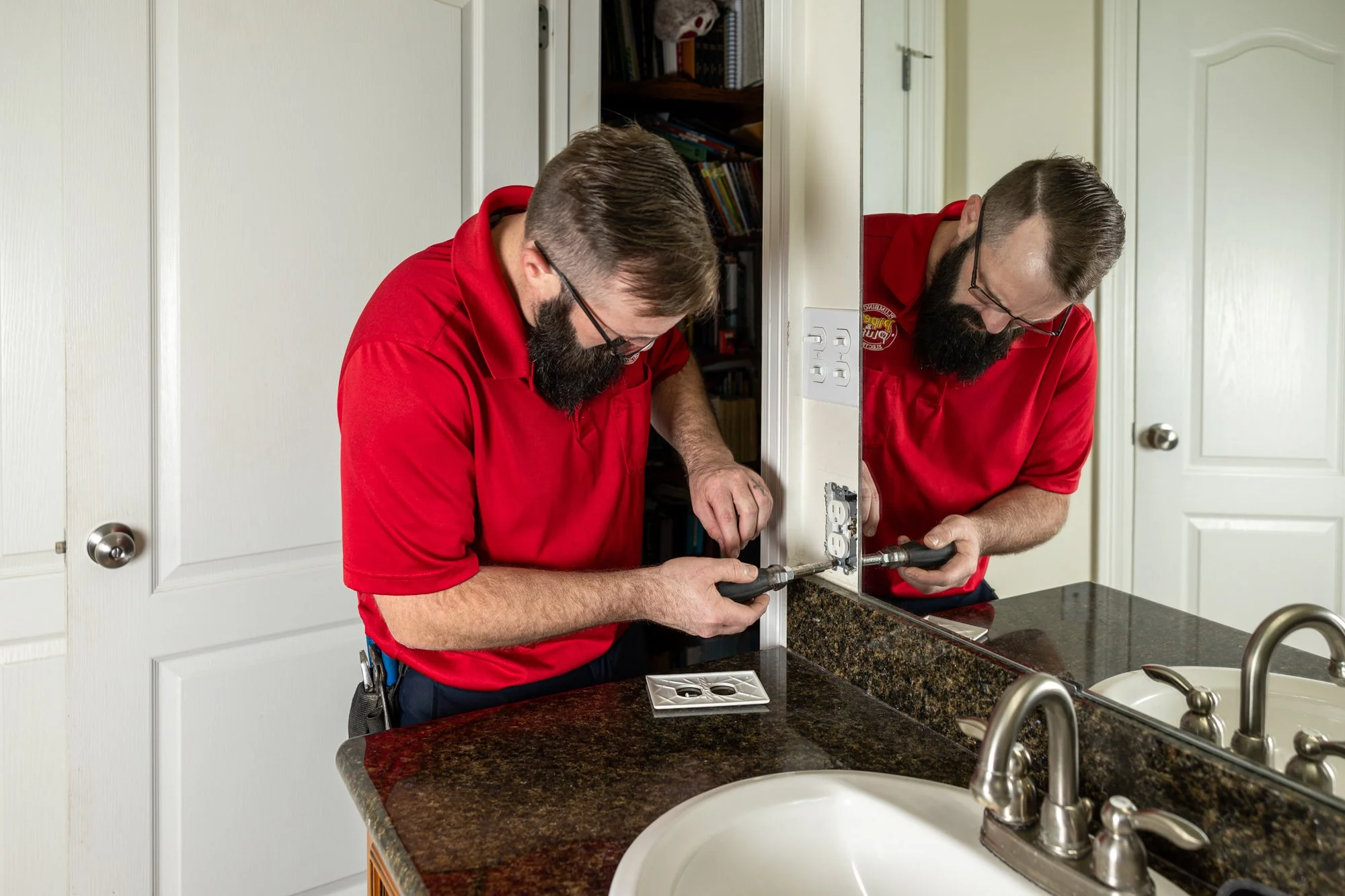
We start by confirming which outlets are on the circuit and what is protecting them, because the wiring is not always what the previous owner or the previous contractor thought it was. Then we test the device itself, check the box for moisture and heat damage, look at the terminations, and put a meter on the circuit to see whether the fault is in a device or in the wire.
Most of the time it ends with a replaced GFCI and a working circuit, done in one visit. When we find something bigger, like damaged wiring in the attic or a circuit that was never grounded properly, we show you what we found and give you the options with prices before we do anything. If the panel itself turns out to be the weak link, that conversation moves to an electrical panel upgrade, but we are not going to steer you there unless the evidence takes us there.
Our electricians and plumbers work under one roof, which means one company, one call, and one crew that already knows your house.
Test your GFCIs before they surprise you
A GFCI that has not been tested in years may not actually protect anyone. Press TEST once a month, confirm the power cuts, then press RESET. It takes ten seconds. We put together a short walkthrough on that here: how to test your GFCIs.
Frequently asked questions
Why did my bathroom outlet stop working when nothing happened in the bathroom?
Because the GFCI protecting it is probably in another room. Bathrooms are often wired downstream of a garage or exterior GFCI. Find that one and reset it.
Is it safe to keep resetting a GFCI that keeps tripping?
No. It is doing its job by tripping. Repeated resets on a device that keeps cutting out means you are overriding a warning about a real fault. Get it diagnosed.
How long do GFCI outlets last?
Generally ten to fifteen years, sometimes less in a damp garage or an outdoor box. They wear out quietly, which is why the monthly test matters.
Does a GFCI protect against overloads?
No. A GFCI protects against ground faults and shock. Overloads are the breaker's job. They are two different protections and a home needs both.
Can I replace a GFCI outlet myself?
Some homeowners do. The wiring has a line side and a load side, and getting them backwards leaves the downstream outlets unprotected while everything appears to work fine, which is the dangerous failure mode. If you are not certain which is which, have a licensed electrician do it.
Get your outlets working again
If you have reset every button you can find and the power is still out, or the GFCI keeps tripping the moment you reset it, call Pipes & Plugs at (337) 364-2980 or schedule your service online. A licensed electrician will trace the circuit, find the actual fault, and fix it, with upfront pricing and a free estimate. Most repairs are backed by our 5-year workmanship warranty. Fixed right the first time.