
House Rewiring Cost in Louisiana: Signs Your Old Wiring Needs Replacing
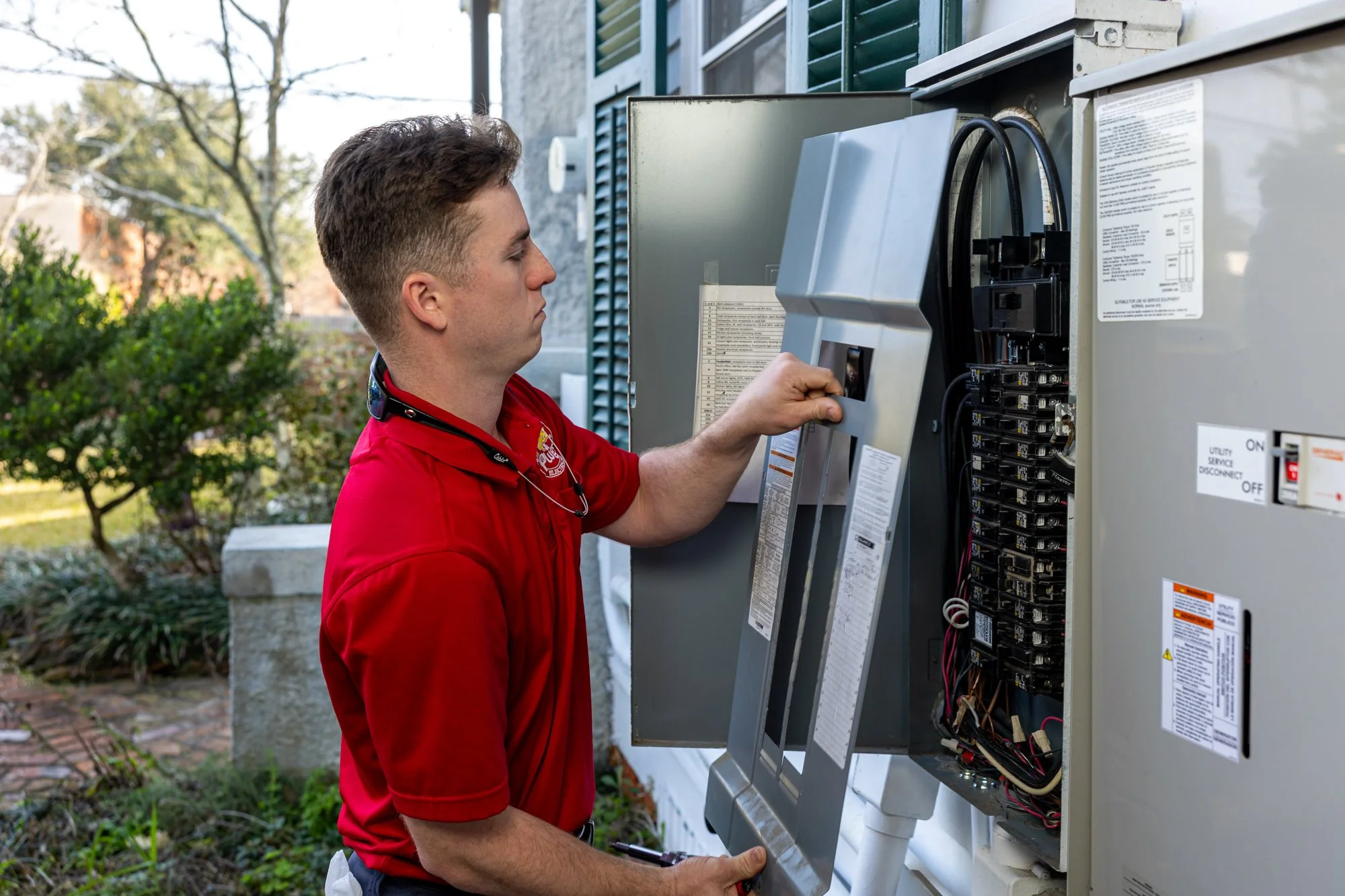
Rewiring a house in Louisiana usually runs somewhere in the low-to-mid five figures for a full job on an average-sized home, and a partial rewire of one problem area is often a fraction of that.
The spread is wide because the price is driven almost entirely by how hard it is to reach the wire, not by the wire itself. Before you worry about the number, the more useful question is whether your home actually needs it, and plenty do not.
Our house rewiring crews look at a lot of older Acadiana homes and tell people no more often than people expect.
Signs your wiring is the problem
Old wiring rarely fails all at once. It tells you first.
Breakers that trip on the same circuit over and over
An occasional trip is a circuit doing its job. The same breaker going every week, especially when you are not running anything unusual, means the circuit is overloaded or the wiring on it is degraded.
Lights that dim when an appliance kicks on
If the living room dims every time the air handler or the fridge compressor starts, the circuit is struggling to keep up. In a home with modern demand and 1960s wiring, that is common.
Warm outlets or switch plates
Electricity should not produce heat you can feel through a faceplate. Warmth means resistance somewhere in the connection, and resistance is what starts fires.
Discolored or scorched outlets
Brown staining around a receptacle is a record of heat that has already happened. Do not use that outlet and get it looked at.
Two-prong outlets throughout the house
Two-prong outlets mean no ground wire. Beyond the shock risk, ungrounded circuits do not protect modern electronics and cannot legally serve a lot of what people plug in today.
A burning or fishy smell with no source
Overheating wire insulation gives off a distinct acrid smell. Some modern insulation smells faintly of fish when it cooks. Either one is an immediate call, not a wait-and-see.
Cloth-covered, knob and tube, or aluminum wiring
These are age markers. Cloth insulation on branch wiring points to a pre-1960s install and the insulation is usually brittle by now. Knob and tube is older still, and we cover it in detail in knob and tube wiring 101. Aluminum branch wiring, common in homes built roughly 1965 to 1973, expands and contracts at connections and works itself loose over time. Aluminum does not always mean a full rewire, but it always means an inspection.
What drives the price
Six things move the number, and only one of them is the house size.
Access. This is the big one. A home with a walkable attic and a crawl space is straightforward to fish. A slab home with a low, tight attic and no crawl space means opening walls and patching afterward, and that changes the job completely. Louisiana has a lot of the second kind.
Square footage and circuit count. More rooms means more runs, more devices, more terminations.
Panel condition. A rewire into an undersized or obsolete panel is a rewire you will redo. Most full rewires include a panel replacement, which we break down separately in our guide to electrical panel replacement cost.
Full versus partial. Not every house needs everything replaced. If the kitchen and bath circuits are the problem and the bedroom runs are sound, we say so.
Code requirements triggered by the work. Rewiring pulls the house up to current code in the areas touched: GFCI protection in wet areas, arc-fault protection on living-space circuits, tamper-resistant receptacles, proper grounding. These add cost and they are not optional.
Repair and finish work. Someone has to patch and paint the drywall that gets opened. Whether that is in the electrical quote or a separate trade changes what you compare.
Anyone who gives you a firm rewiring price over the phone without seeing the attic is guessing. We are not going to do that.
When you do not need a full rewire
A few situations get mistaken for "needs rewiring" and are not:
The panel is the problem, not the wire. A tired or recalled panel on otherwise sound branch circuits is a panel job.
One overloaded circuit. Older kitchens frequently run on one 15-amp circuit that was fine in 1968. Adding a dedicated circuit or two solves it.
No grounding at a handful of outlets. In some cases, GFCI protection on those outlets is a code-compliant fix that does not require pulling new wire everywhere.
A single bad run. One damaged cable in an attic is a repair.
We would rather sell you the smaller job that fixes the problem than the big one that impresses the invoice.
What a rewire looks like from your side

An electrician maps the existing circuits and inspects the wire in the attic, at the panel, and behind a sample of devices. You get a written scope and price. On the job, we run new cable to each device, replace outlets and switches, tie everything into a new or existing panel, get it inspected, and patch what had to be opened.
On an average home it typically runs several days to a couple of weeks depending on access, and the power comes off in sections so you are not without electricity the whole time. Most of our work carries a 5-year workmanship warranty.
Frequently asked questions
How long does it take to rewire a house?
For most homes, several days to two weeks. Access is the driver again. A rewire that can be run through a good attic and crawl space goes much faster than one requiring wall openings.
Can I live in the house during a rewire?
Usually yes. We stage the work and shut off power section by section rather than all at once. Expect some rooms to be out of service on any given day and expect dust.
Do I have to rewire before I can sell?
Not by law, but knob and tube or aluminum branch wiring will show up in a buyer's inspection and can affect their insurance. Some carriers will not write a policy on knob and tube at all. It commonly becomes a negotiation point.
Is aluminum wiring dangerous?
It needs attention, not panic. The risk is at connections, where aluminum loosens over time and heats up. There are approved repair methods that address the terminations without replacing every run, and a licensed electrician can tell you whether yours qualifies.
Does homeowners insurance pay for rewiring?
Not as a maintenance item. Insurance responds to sudden damage, not to wiring that has aged out. Ask your agent whether your current wiring type affects your premium, because sometimes it does.
Will a rewire increase my home's value?
It is not a flashy upgrade, but it removes an inspection problem, opens up insurance options, and lets the house handle modern electrical load. Buyers notice the absence of a problem more than they notice a feature.
Find out what your house actually needs
Before you budget for a rewire, get someone licensed into the attic and the panel. Call Pipes & Plugs at (337) 364-2980 or schedule your service online, and a licensed electrician will inspect the wiring, tell you plainly whether it needs replacing, and give you a written price with a free estimate. If it turns out you need a partial job or no job at all, that is what we will tell you. Serving New Iberia, Lafayette, and the surrounding Acadiana communities.